What?
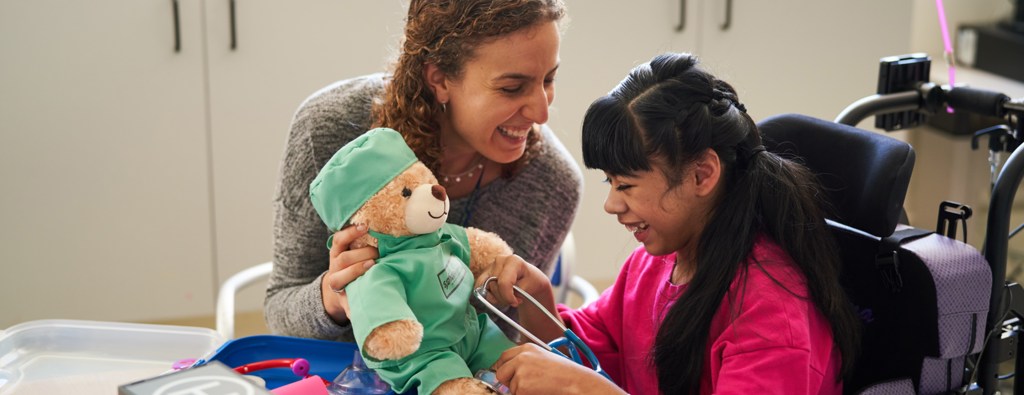
The field of Child Life involves helping children and their families cope with stressful health-related situations. The day-to-day experience can vary widely, but common activities include play, distraction, education, advocacy, and coping skills, to reduce the long-term effects of stress, anxiety, and psychosocial trauma. According to the Association of Child Life Professionals (ACLP), these providers work collaboratively with other healthcare team members to “bring a multifocal lens to pediatric patients and their families – one that is rooted in developmental theory, centered upon the value of therapeutic relationships, and informed about the influence of present and prior trauma” and they note that “play is the vehicle by which coping skills are taught and refined, illness information is shared and revised, resilience is found and exercised, and emotional safety is created and maintained.” Illness, injury, surgery, chronic disability, and other health issues are complex experiences, made even more sensitive when endured by children, and this field endeavors to provide relevant knowledge, expertise, and support to these vulnerable individuals and their families. This field and its providers are sometimes referred to as “Child Life Specialists,” “Child Life Services,” “Child Life Professionals,” “Child Life Programming,” or other similar titles. For simplicity, on this page we will mostly refer to the field as “CLS” for short.
Who?
In CLS, as the name implies, it is crucial to enjoy working with children. These professionals have a wide variety of skills including developmentally appropriate communication, ability to relate with kids, and compassion for the pediatric population. Similarly, it is important to be able to build rapport with family members/caregivers of a child because they can also be impacted by stressful situations such as hospitalization. The CLS must be mindful and respectful of the extremely wide diversity of backgrounds, identities, and family structures of those they serve, connecting with each individual within their unique experience. CLS workers are flexible, creative, fun-loving, professional, empathic, and communicative. If you have a love for children and are interested in utilizing these skills in a health-related context, then perhaps CLS is a great career path for you!
Where?
By far, the most common work setting of a CLS is healthcare related, such as in-patient hospitals and outpatient clinics. However, they can also be found in a wide variety of spaces including schools, dentist offices, courts, and more. For some examples of local workplaces, explore this list of hospitals which feature a CLS unit provided by the Great Lakes Association of Child Life Professionals (GLACLP).
How?
To become a Certified Child Life Specialist (CCLS), there are three main requirements, described below. For help with all this, check out the GLACLP’s informational page about educational opportunities for students, as well as the ACLP’s Certification Eligibility Assessment.
1) The first step is academic preparation, which includes the completion of a specific set of coursework as well as completion of a college Bachelor’s degree (e.g., B.A., B.S., or B.S.W.) in a relevant subject (e.g., Psychology, Social Work, Child Development). One can either complete the coursework and Bachelor’s degree together as part of an ACLP-Endorsed program (see list of approved programs here) or complete a Bachelor’s degree and complement it by adding a specific set of ten courses at the same campus or transferred into one’s transcripts from elsewhere (see list of specific courses required here).
2) Secondly, one must complete a 600-hour clinical internship approved by the ACLP. These are typically full-time roles intended to ready the individual for independent practice. Most internships are completed in hospitals under the direct supervision of a CCLS. The ACLP has a standardized internship application which students can submit for any hospital where they are interested to intern. Applying for an internship requires that the student has completed the preliminary coursework and has experience working with children both in and out of the healthcare setting. Learn more about the internship application process here.
3) Third and finally, one must pass the ACLP’s standardized Child Life Certification Exam. This certification is nation-wide, so a CCLS is thus able to practice in Michigan as well as any other US state or territory. While specific employers may have hierarchical position titles and ‘ladders’ one can climb in this career, and while there are indeed advanced degrees available specializing in the Child Life and Child Development fields (e.g., master’s or doctoral degrees in Developmental Psychology), the CCLS certification through ACLP is the national gold standard and terminal requisite to practice in the CLS field.
Why?
CLS professionals enjoy their work because it is such a unique way to impact the healthcare experiences of families outside of the medical care they receive. Their services really round out patient care, making it less scary and maybe even a little fun! Being in the hospital can be such a difficult experience for everyone involved, and the CLS’ ability to support children and families along the way is truly special. Experiences such as helping an anxious teen to prepare for a serious medical procedure and eventually feel mastery over it, assisting a young child with normalizing the day-to-day routine during their inpatient stay, building a positive relationship over time with someone frequently admitted to the hospital pediatric unit, and many others make the work of a CLS deeply rewarding. These professionals report that their work is challenging but also very satisfying and enjoyable.
Relevant State-Level Organization
Great Lakes Association of Child Life Professionals
Relevant National Organization
Association of Child Life Professionals
 MI Mental Health Helping Professions